
General Information
© Alain Herzog
Themes
Plasma physics topics that will be included in the 53rd conference programme include:
- Magnetic Confinement Fusion
- Beam Plasma and Inertial Fusion
- Low Temperature Plasmas
- Basic, Space and Astrophysical Plasmas
Goals
The objectives of this conference are aligned with those of the EPS Plasma Physics Division:
- To unite European scientists interested in the physics of fully and partially ionized gases.
- To promote research and teaching in plasma physics and its applications, to facilitate research collaborations.
- To share ideas, results and joint activities with the physicists of other physical societies
Committees
Programme Committee
- to be nominated
Local Organising Committee
Venue
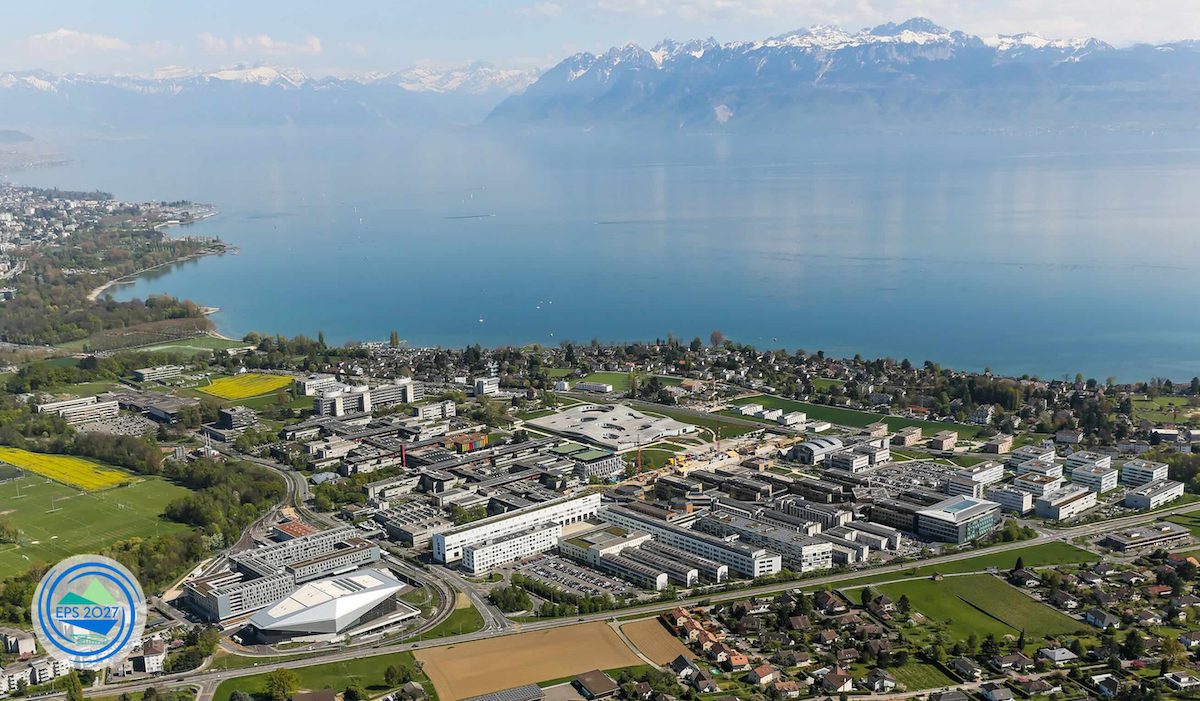
The EPS 2027 will be held at the SwissTech Convention Center in Lausanne, Switzerland. Located on the campus of EPFL and easily accessible by public transport, the SwissTech Convention Center offers a modern, world-class venue for international conferences and events. Details on how to reach the SwissTech Convention Center can be found here.
EPFL
The Swiss Plasma Center at EPFL (École Polytechnique Fédérale de Lausanne) is a world leader in fusion research and plasma applications. It hosts the Tokamak à Configuration Variable (TCV), one of only four major fusion research facilities in Europe. The Swiss Plasma Center also hosts several low-temperature plasma experiments, including TORPEX and RAID, and it develops biological applications of plasma. Theory and numerical modeling activities at the Swiss Plasma Center cover first principle based simulations of plasma turbulence, MHD analysis of equilibrum and stability properties in tokamaks and stellarators, as well as the modelling of experimental results. The Swiss Plasma Center superconductivity activities have two main focuses: testing fusion-device superconductors with the unique SULTAN facility, and developing next-generation technologies through coil design for future installations and high-temperature superconductors
Our diverse international team of researchers, engineers, and students collaborates through a comprehensive program of research and training, advancing our understanding of plasma physics and driving fusion toward a central role in the energy transition. The Swiss Plasma Center is part of EPFL’s School of Basic Sciences and actively participates in the EUROfusion Consortium. Through this network, we contribute to Europe’s leading-edge fusion research initiatives.